
Quick answer: A charger is not just a cable. It’s a mains-connected electrical product, and the cheapest listings online are where counterfeit and uncertified ones turn up. Health Canada says not to buy plug-in electrical products without a Canadian certification mark such as CSA, cUL or cETL, and that the mark must be on the product itself, not just the packaging. When you buy from a local Saskatoon phone shop, you can check those marks in your hand, ask questions and bring it back if it fails. The best charging accessories are ones that carry the right marks, match your phone’s power needs and come from a seller you can find again.
Why cheap cables and chargers keep failing
You know the cycle. A $4 cable arrives from an online seller. It works for a few weeks, then starts charging only at a certain angle, charges slowly, disconnects, or stops completely. So you buy another. After a year you’ve spent more than a good cable would have cost, and you’ve still got a drawer full of dead ones.
Failures like these usually come down to build quality:
- Thin wires and weak strain relief where the cable bends.
- Poorly made connectors that wear loose.
- Chargers that can’t actually deliver the power they claim.
- Counterfeit products designed to look like trusted brands.
Most of that is annoying and wasteful. Some of it is a safety issue.
It’s not just annoying: the safety side
Chargers plug into a wall outlet and convert mains power. That’s why they’re regulated differently from, say, a phone case.
Health Canada’s guidance is direct. It says counterfeit electrical products don’t meet Canadian safety standards and may be sold for an unusually low price to attract consumers. Health Canada has also warned about USB wall chargers that posed an unacceptable risk of shock, burn or fire; in a 2020 notice it advised consumers to stop using the recalled products immediately and to use only certified electrical products.
A 2016 UL study, as reported by Interesting Engineering, tested 400 counterfeit iPhone chargers and found that only three provided enough insulation against electric shock in a basic safety test. That study is old and specific to counterfeit Apple adapters, so treat it as an illustration of the risk, not a statement about any particular product today.
None of this means every cheap charger is dangerous, or that everything sold online is bad. It means the cheapest, no-name listings are the ones where the safety marks are most likely to be missing or fake.
What to look for: the certification mark
Health Canada says to check for a Canadian certification mark such as CSA, cUL or cETL before buying a plug-in electrical product, and not to buy or use one without a mark. Two details matter:
- The mark must be on the product itself. Health Canada says it must appear on the product, not just the packaging, because a box is easy to copy.
- It should come from an accredited body. The marks are issued by certification bodies accredited by the Standards Council of Canada.
This is the single easiest check, and it’s one you can do in seconds when the charger is in your hand and impossible to do on a product photo.
What to look for in a cable
Cables don’t plug into the wall, so they aren’t covered by the same mark. They still vary a lot. Things to check:
- Strain relief. The part where the cable meets the connector should be reinforced, since that’s where most cables break.
- Connector fit. It should click in firmly with no wobble.
- Power rating (for USB-C). For USB-C to USB-C cables, the USB Implementers Forum says cables must be labelled with a power capability of 60W or 240W, and the logo has to be verified during compliance testing before a cable can carry it. A cable with no clear rating tells you little about what it can handle.
- Condition. Health Canada advises checking cords regularly for fraying or damage that could be a shock or fire hazard.
What to look for in a charger (wall adapter or power bank)
- A certification mark on the charger, as above.
- Power that matches your phone. Health Canada says to confirm the product is rated for your intended use, including power, voltage and current. If you’re unsure what your phone needs, ask.
- Solid build. It shouldn’t rattle, feel unusually light or have loose prongs.
- Heat. It’s normal to be warm. If it gets uncomfortably hot, stop using it.
- Where you use it. Health Canada says not to place chargers near combustible materials or on soft surfaces, such as a couch or bed.
Red flags in an online listing
- A price far below what similar products cost. Health Canada notes counterfeits are often priced unusually low.
- Photos that don’t show the certification mark on the product.
- Misspellings, missing details or vague specs in the listing.
- A seller you can’t identify, with no way to return the product.
- Brand names with slightly “off” packaging or logos.
- Reviews that look copied, or that mention overheating or quick failure.
Health Canada’s advice is simple: buy from a seller you trust, and check the recalls and safety alerts database to make sure the product isn’t recalled.
Why buy charging accessories from a local phone shop
To be fair, there are good chargers and cables sold online by reputable sellers. The advantage of a local shop isn’t that online is always bad. It’s what you can do in person:
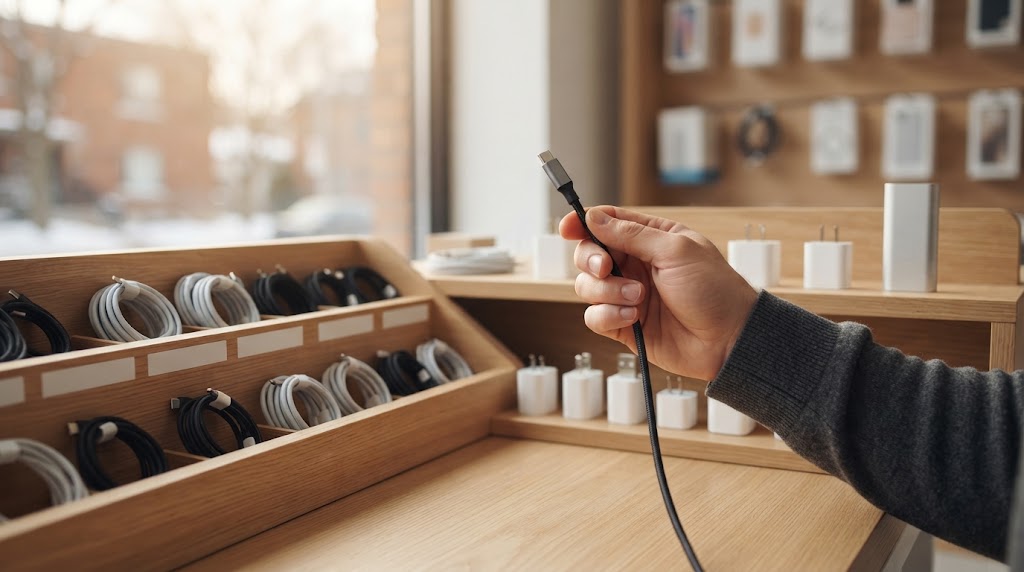
- You can inspect the product. Pick it up, look for the mark on the charger itself and check the connector.
- You can ask questions. What does my phone need? Will this work with my tablet too?
- You can return it to a shop you can walk into if it fails, instead of dealing with an overseas seller.
- You can get a diagnosis. If charging is flaky, a technician can tell whether it’s the cable, the adapter or the phone’s charging port.
- You’re supporting someone local who’s accountable to the neighbourhood.
Charging problems that aren’t the cable
Sometimes a new cable doesn’t fix slow or unreliable charging. The cause may be:
- A worn or dirty charging port. Lint and debris can stop a cable seating fully.
- A weak battery. Phones that drain fast or shut off unexpectedly may need a replacement. See our guide on signs your iPhone battery needs replacing.
- Software or settings issues.
A technician can check which it is before you spend money on more cables.
Charging accessories at 22nd Cellphone
22nd Cellphone is a Saskatoon phone and computer repair shop that has operated since 2018, according to our website, repairing smartphones, laptops, tablets, iPads and gaming consoles, and selling phone accessories. Call 306 979 0412.
If you’re a student, our back-to-school tech check lists what to fix before classes start.
A quick in-store checklist
Before you buy any charger or cable, ask yourself:
- Is there a CSA, cUL or cETL mark on the charger itself?
- Does it match my phone’s power needs?
- Is the cable’s strain relief solid, and does the connector fit firmly?
- Is the USB-C cable’s power rating clearly marked?
- Does the seller stand behind it with a return or warranty?
- Is the price in line with similar products, not suspiciously low?
Frequently Asked Questions
Are cheap phone chargers from online sellers safe?
Some are, but the cheapest no-name listings carry more risk. Health Canada says counterfeit electrical products don’t meet Canadian safety standards and are often sold for unusually low prices. Look for a certification mark on the product and buy from a seller you trust.
What certification mark should a phone charger have in Canada?
Health Canada says to look for a Canadian certification mark such as CSA, cUL or cETL. The mark must be on the product itself, not just the packaging.
How can I tell if a charger or cable is fake?
Check for a certification mark on the product, a price far below similar items, misspellings or missing details in the listing, and signs of poor build. Health Canada advises that if you suspect a product is counterfeit, stop using it immediately.
Why does my charging cable stop working after a few weeks?
Usually build quality: weak wires, poor strain relief or worn connectors where the cable bends. If a new cable doesn’t help, the problem may be a dirty or worn charging port or a weak battery, which a technician can check.
What does the 60W or 240W logo on a USB-C cable mean?
The USB Implementers Forum says USB-C to USB-C cables must be labelled with a power capability of 60W or 240W, and the logo is verified during compliance testing before a cable can carry it. It tells you how much power the cable is designed to handle.
Can I use any charger with my phone?
Not necessarily. Health Canada says to confirm a product is rated for your intended use, including power, voltage and current. Ask a technician what your phone and tablet need.
How do I know if a charger has been recalled?
Health Canada recommends checking the recalls and safety alerts database before you buy, and stopping use of any recalled product.
Where can I buy phone chargers and cables in Saskatoon?
At a local phone shop where you can inspect the product and return it if it fails. 22nd Cellphone sells phone accessories and repairs phones in Saskatoon. Call 306 979 0412.